
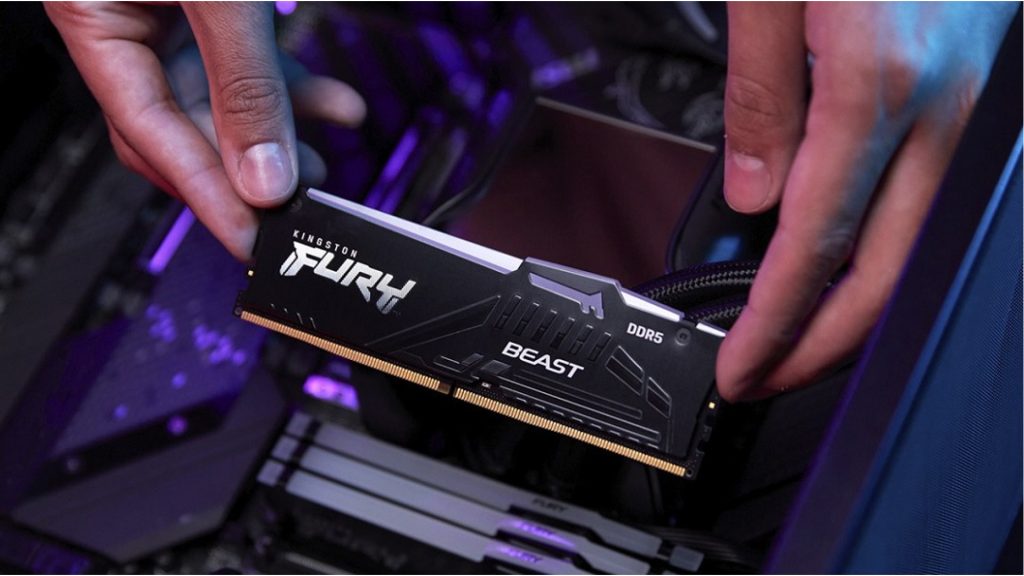
In most real-world scenarios, RAM frequency (speed) tends to have a bigger impact on performance than timings, but the true latency depends on both. The best RAM is a balance: high frequency with relatively low timings.
🔑 Key Concepts
RAM Frequency (Speed)
- Measured in MHz or MT/s (e.g., DDR4-3200 = 3200 MT/s).
- Indicates how many millions of data transfers per second the RAM can perform.
- Higher frequency = faster data throughput.
- Example: DDR4-3600 is faster than DDR4-2400.
RAM Timings (Latency)
- Represented as numbers like CL16-18-18-38.
- CAS Latency (CL) is the most important: the delay (in clock cycles) between a read request and data availability.
- Lower timings = faster response.
- Other timings include:
- tRCD (Row-to-Column Delay)
- tRP (Row Precharge Time)
- tRAS (Row Active Time)
⚖️ Which Matters More?
- Frequency usually has a more noticeable impact on performance, especially in gaming or workloads needing high CPU bandwidth.
- Timings matter for responsiveness: lower CAS latency reduces delay in accessing data.
- The real performance depends on true latency, calculated in nanoseconds:
[ \text{True Latency (ns)} = \frac{CL}{\text{Frequency}/2} \times 1000 ]
- Example:
- DDR4-3600 CL16 ≈ 8.9 ns
- DDR4-4000 CL19 ≈ 9.5 ns → Even though DDR4-4000 has higher frequency, DDR4-3600 CL16 is actually faster in latency.
📊 Comparison Table
| Spec | DDR4-3200 CL16 | DDR4-3600 CL16 | DDR4-4000 CL19 |
|---|---|---|---|
| Frequency | 3200 MT/s | 3600 MT/s | 4000 MT/s |
| CAS Latency | 16 cycles | 16 cycles | 19 cycles |
| True Latency | ~10 ns | ~8.9 ns | ~9.5 ns |
| Performance | Moderate | Excellent balance | High bandwidth but slower latency |
Sources:
🎮 Practical Advice
- For gaming, frequency often matters more, but tight timings improve 1% low FPS (reducing stutter).
- For content creation/AI workloads, higher frequency helps with bandwidth-heavy tasks.
- Best sweet spot today:
- DDR4: 3600 MHz CL16
- DDR5: 6000 MHz CL30–36
- Always check compatibility with your CPU (e.g., AMD Ryzen benefits from RAM frequency matching Infinity Fabric).
👉 In short: Frequency gives raw speed, timings give responsiveness. The real-world winner is the kit with the lowest true latency (ns), not just the highest MHz. Would you like me to calculate the true latency for a specific RAM kit you’re considering?